
Papers in 2026
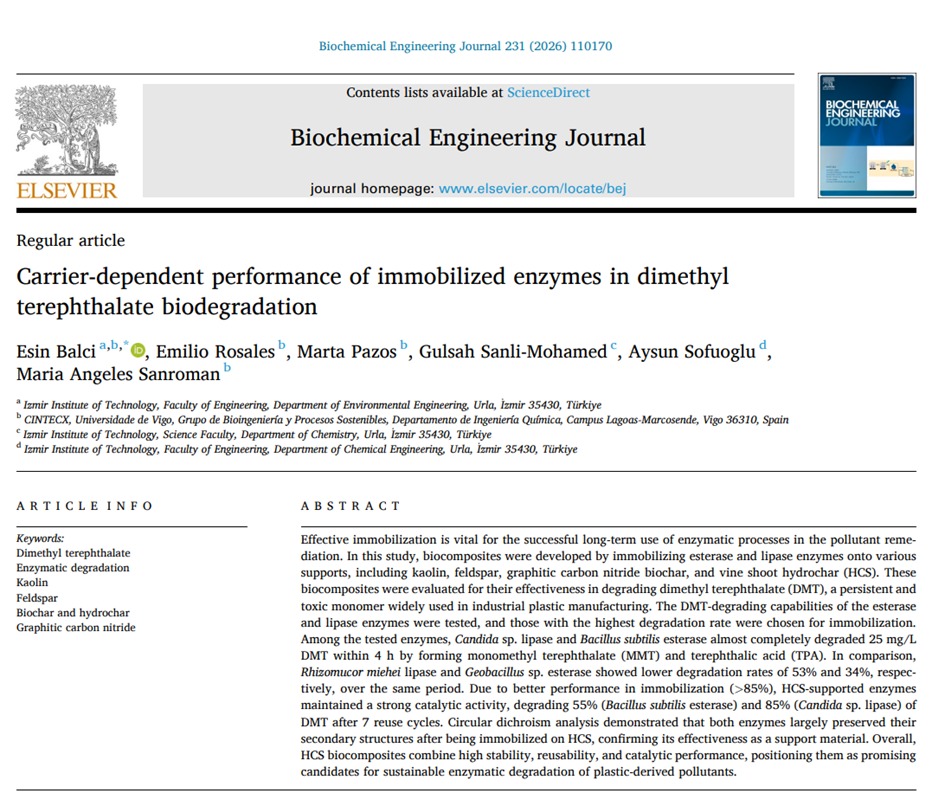
Carrier-dependent performance of immobilized enzymes in dimethyl terephthalate biodegradation
Effective immobilization is vital for the successful long-term use of enzymatic processes in the pollutant remediation. In this study, biocomposites were developed by immobilizing esterase and lipase enzymes onto various supports, including kaolin, feldspar, graphitic carbon nitride biochar, and vine shoot hydrochar (HCS). These biocomposites were evaluated for their effectiveness in degrading dimethyl terephthalate (DMT), a persistent and toxic monomer widely used in industrial plastic manufacturing. The DMT-degrading capabilities of the esterase and lipase enzymes were tested, and those with the highest degradation rate were chosen for immobilization. Among the tested enzymes, Candida sp. lipase and Bacillus subtilis esterase almost completely degraded 25 mg/L DMT within 4 h by forming monomethyl terephthalate (MMT) and terephthalic acid (TPA). In comparison, Rhizomucor miehei lipase and Geobacillus sp. esterase showed lower degradation rates of 53% and 34%, respectively, over the same period. Due to better performance in immobilization (>85%), HCS-supported enzymes maintained a strong catalytic activity, degrading 55% (Bacillus subtilis esterase) and 85% (Candida sp. lipase) of DMT after 7 reuse cycles. Circular dichroism analysis demonstrated that both enzymes largely preserved their secondary structures after being immobilized on HCS, confirming its effectiveness as a support material. Overall, HCS biocomposites combine high stability, reusability, and catalytic performance, positioning them as promising candidates for sustainable enzymatic degradation of plastic-derived pollutants.
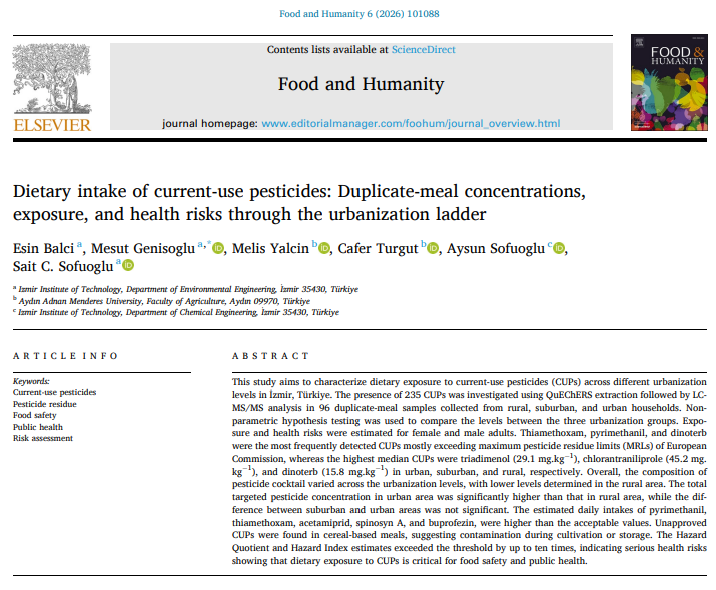
Dietary intake of current-use pesticides: Duplicate-meal concentrations, exposure, and health risks through the urbanization ladder
This study aims to characteri dietary exposure to current use pesticides (CUPs) across different urbanization levels in Izmir, Türkiye. The presence of 235 CUPs was investigated using QuEChERS extraction followed by LCMS/MS analysis in 96 duplicate-meal samples collected from rural, suburban and urban households. Nonparametric hypothesis testing was used to compare the levels between the three urbanization groups. Exposure and health risks were estimated for female and male adults. Thiamethoxam, pyrimethanil, and dinoterb were the most frequently detected CUPs mostly exceeding maximum pesticide residue limits (MRLs) of European Commission, whereas the highest median CUPs were triadimenol (29.1 mg.kg− 1 ), chlorantraniliprole (45.2 mg. kg− 1 ), and dinoterb (15.8 mg.kg− 1 ) in urban, suburban, and rural, respectively. Overall, the composition of pesticide cocktail varied across the urbanization levels, with lower levels determined in the rural area. The total targeted pesticide concentration in urban area was significantly higher than that in rural area, while the difference between suburban and urban areas was not significant. The estimated daily intakes of pyrimethanil, thiamethoxam, acetamiprid, spinosyn A, and buprofezin, were higher than the acceptable values. Unapproved CUPs were found in cereal based meals, suggesting contamination during cultivation or storage. The Hazard Quotient and Hazard Index stimates exceeded the thres old by up to ten times, indicating serious health risks showing that dietary exposure to CUPs is critical for food safety and public health.
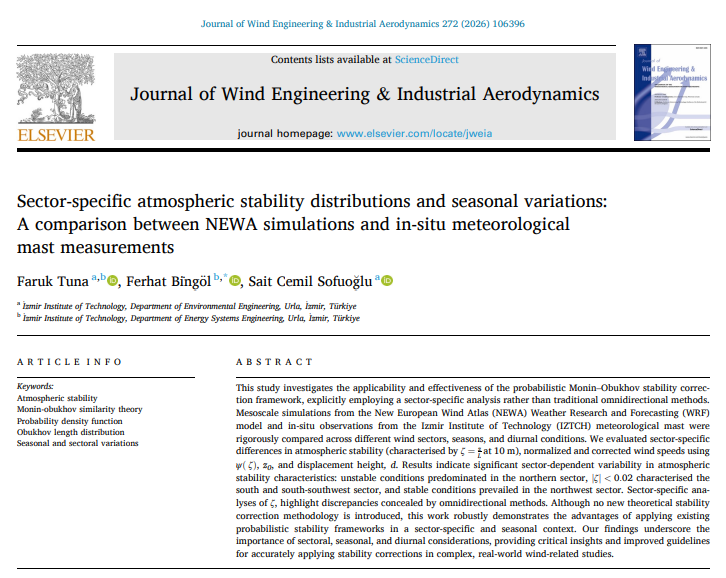
Sector-specific atmospheric stability distributions and seasonal variations: A comparison between NEWA simulations and in-situ meteorological mast measurements
This study investigates the applicability and effectiveness of the probabilistic Monin–Obukhov stability correction framework by explicitly employing a sector specific analysis rather than traditional omnidirectional methods. Mesoscale simulations from the New European Wind Atlas (NEWA) Weather Research and Forecasting (WRF) model and in situ observations from the Izmir Institute of Technology (IZTECH) meteorological mast were rigorously compared across different wind sectors, seasons, and diurnal conditions. We evaluated sector specific differences in atmospheric stability, characterized by ζ = z/L at 10 m, and analyzed normalized and corrected wind speeds using ψ(ζ), z0, and displacement height, d. The results indicate significant sector dependent variability in atmospheric stability characteristics. Unstable conditions predominated in the northern sector, |ζ| < 0.02 characterized the south and south southwest sector, and stable conditions prevailed in the northwest sector. Sector specific analyses of ζ highlight discrepancies that are concealed by omnidirectional methods. Although no new theoretical stability correction methodology is introduced, this work robustly demonstrates the advantages of applying existing probabilistic stability frameworks within a sector specific and seasonal context. Our findings underscore the importance of sectoral, seasonal, and diurnal considerations, providing critical insights and improved guidance for accurately applying stability corrections in complex, real world wind related studies.
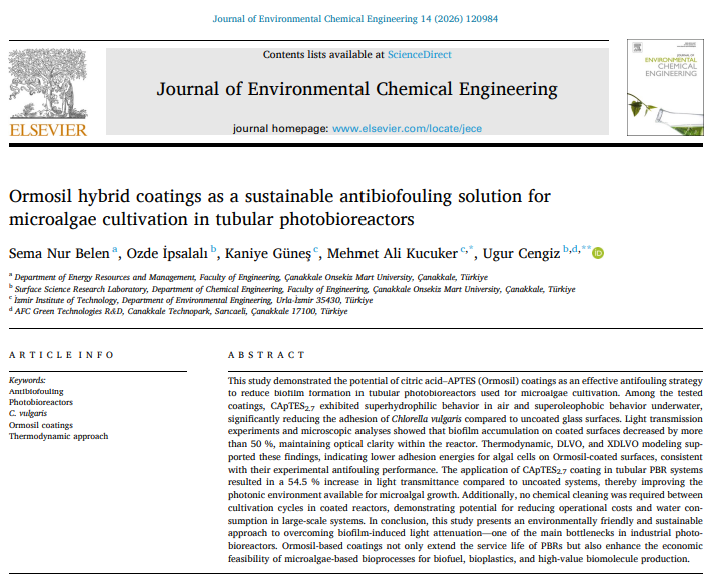
Ormosil hybrid coatings as a sustainable antibiofouling solution for microalgae cultivation in tubular photobioreactors
This study demonstrated the potential of citric acid–APTES (Ormosil) coatings as an effective antifouling strategy to reduce biofilm formation in tubular photobioreactors used for microalgae cultivation. Among the tested coatings, CApTES2.7 exhibited superhydrophilic behavior in air and superoleophobic behavior underwater, significantly reducing the adhesion of Chlorella vulgaris compared to uncoated glass surfaces. Light transmission experiments and microscopic analyses showed that biofilm accumulation on coated surfaces decreased by more than 50 %, maintaining optical clarity within the reactor. Thermodynamic, DLVO, and XDLVO modeling supported these findings, indicating lower adhesion energies for algal cells on Ormosil-coated surfaces, consistent with their experimental antifouling performance. The application of CApTES2.7 coating in tubular PBR systems resulted in a 54.5 % increase in light transmittance compared to uncoated systems, thereby improving the photonic environment available for microalgal growth. Additionally, no chemical cleaning was required between cultivation cycles in coated reactors, demonstrating potential for reducing operational costs and water consumption in large-scale systems. In conclusion, this study presents an environmentally friendly and sustainable approach to overcoming biofilm-induced light attenuation—one of the main bottlenecks in industrial photobioreactors. Ormosil-based coatings not only extend the service life of PBRs but also enhance the economic feasibility of microalgae-based bioprocesses for biofuel, bioplastics, and high-value biomolecule production.
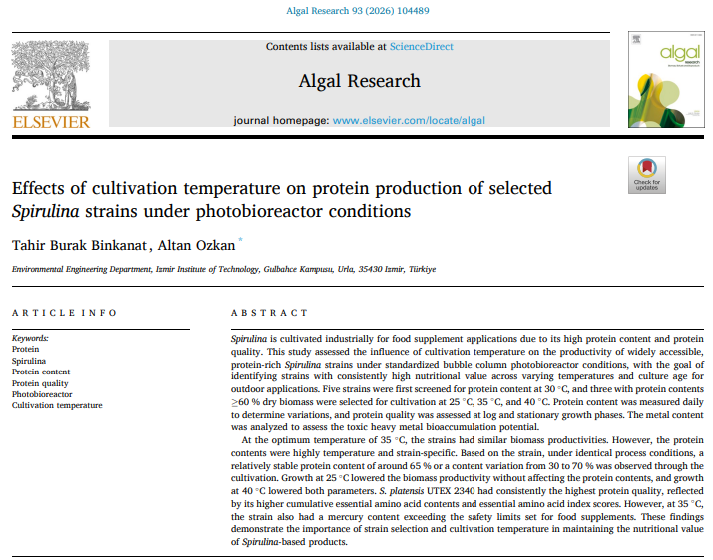
Effects of cultivation temperature on protein production of selected Spirulina strains under photobioreactor conditions
Spirulina is cultivated industrially for food supplement applications due to its high protein content and protein quality. This study assessed the influence of cultivation temperature on the productivity of widely accessible, protein-rich Spirulina strains under standardized bubble column photobioreactor conditions, with the goal of identifying strains with consistently high nutritional value across varying temperatures and culture age for outdoor applications. Five strains were first screened for protein content at 30 °C, and three with protein contents ≥60 % dry biomass were selected for cultivation at 25 °C, 35 °C, and 40 °C. Protein content was measured daily to determine variations, and protein quality was assessed at log and stationary growth phases. The metal content was analyzed to assess the toxic heavy metal bioaccumulation potential. At the optimum temperature of 35 °C, the strains had similar biomass productivities. However, the protein contents were highly temperature and strain-specific. Based on the strain, under identical process conditions, a relatively stable protein content of around 65 % or a content variation from 30 to 70 % was observed through the cultivation. Growth at 25 °C lowered the biomass productivity without affecting the protein contents, and growth at 40 °C lowered both parameters. S. platensis UTEX 2340 had consistently the highest protein quality, reflected by its higher cumulative essential amino acid contents and essential amino acid index scores. However, at 35 °C, the strain also had a mercury content exceeding the safety limits set for food supplements. These findings demonstrate the importance of strain selection and cultivation temperature in maintaining the nutritional value of Spirulina-based products.
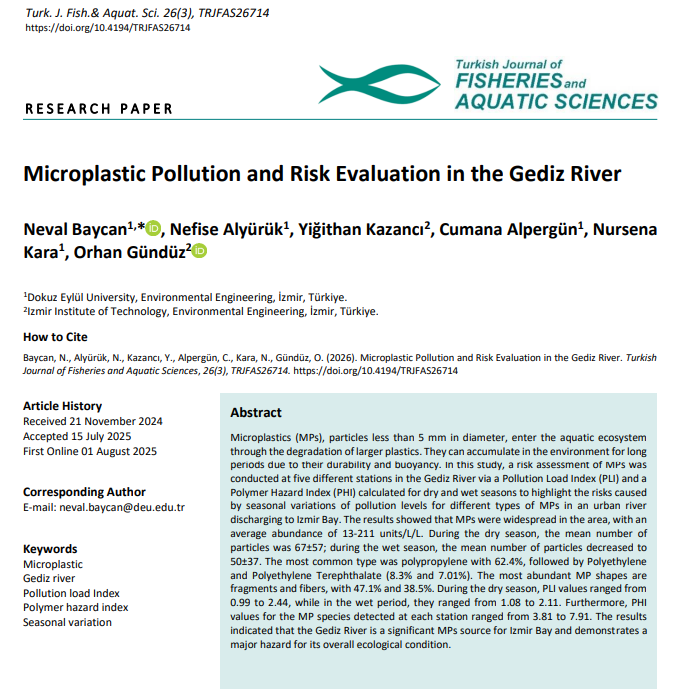
Microplastic Pollution and Risk Evaluation in the Gediz River
Microplastics (MPs), particles less than 5 mm in diameter, enter the aquatic ecosystem through the degradation of larger plastics. They can accumulate in the environment for long periods due to their durability and buoyancy. In this study, a risk assessment of MPs was conducted at five different stations in the Gediz River via a Pollution Load Index (PLI) and a Polymer Hazard Index (PHI) calculated for dry and wet seasons to highlight the risks caused by seasonal variations of pollution levels for different types of MPs in an urban river discharging to Izmir Bay. The results showed that MPs were widespread in the area, with an average abundance of 13 211 units/L/L. During the dry season, the mean number of particles was 67±57; during the wet season, the mean number of particles decreased to 50±37. The most common type was polypropylene with 62.4%, followed by Polyethylene and Polyethylene Terephthalate (8.3% and 7.01%). The most abundant MP shapes are fragments and fibers, with 47.1% and 38.5%. During the dry season, PLI values ranged from 0.99 to 2.44, while in the wet period, they ranged from 1.08 to 2.11. Furthermore, PHI values for the MP species detected at each station ranged from 3.81 to 7.91. The results indicated that the Gediz River is a significant MPs source for Izmir Bay and demonstrates a major hazard for its overall ecological condition.